By Greg Bishop/Illinois Radio Network
SPRINGFIELD – There’s no doubt opioid abuse is a problem in Illinois. Gov. Bruce Rauner wants to do something about it.
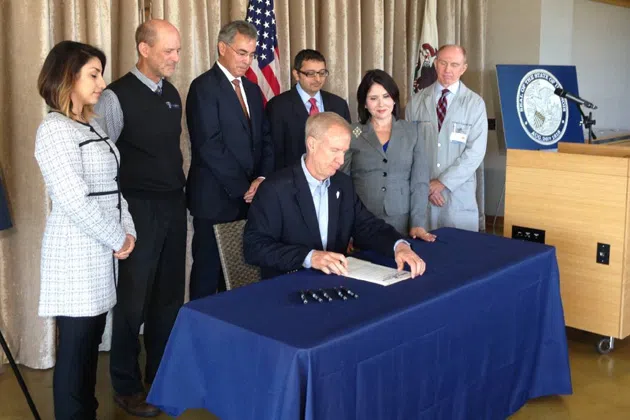
Rauner signed an executive order Wednesday on Chicago’s westside that creates the Governor’s Opioid Prevention and Intervention Task Force.
“This task force is chartered to set specific goals and manage to those goals and actually drive the results,” Rauner said, “not advise, not give recommendations. This is actually driving results.”
Rauner’s office said in a statement the task force will be co-chaired by Lt. Gov. Evelyn Sanguinetti and Illinois Department of Public Health Director Dr. Nirav Shah.
“The task force will look at strategies to prevent expansion of the opioid crisis, treat and promote the recovery of individuals with opioid-use disorder, and reduce the number of opioid overdose deaths,” the release said.
Shah said Wednesday that opioid overdose death statistics are staggering with 1,900 opioid-related deaths last year, nearly twice the number of fatal car wrecks and one-and-a-half times the number of homicides.
“Scarier yet,” Shah said, “the crisis is getting worse by the day. Last year alone saw a 76 percent increase in deaths as compared to just a few years ago.”
One big issue to deal with is the stigma surrounding opioid addiction.
“Until we move from a place of misunderstanding to understanding it will be very difficult to make a dent,” Shah said.
Illinois Department of Human Services Director James Dimas said stigma surrounding substance abuse hurts the individual and their families and must be addressed as part of the solution.
“Fear and shame in coming forward has very real negative consequences on people’s chances of recovery,” Dimas said.
Both Dimas and Shah said treatment works, but must be more available for those suffering from substance abuse.
The task force, according to the governor’s office, will also look at how to increase the number of providers that use the Illinois Prescription Monitoring Program; reduce high-risk opioid prescribing; make information and resources more accessible to the public; strengthen data collection, analysis, and sharing, among other things.
Later in the day in Springfield, an action plan was released that Rauner and Shah said will drive results.
Also, Illinois Treasurer Michael Frerichs has joined state treasurers from three other states, Pennsylvania, West Virginia and California, in sending drug companies Cardinal Health and AmerisourceBergen letters urging them to help address the crisis or face potential financial consequences in their stock prices.
“Should no action be taken,” a statement about the letters to the companies said, “each treasurer’s office would re-evaluate its financial position in the companies and strongly encourage other institutional investors to do the same.”
“The industry needs to acknowledge its role in this crisis,” Frerichs said, “and take immediate action if we have any hope to save lives and stop this national crisis.”